
Social jetlag carries a measurable overnight autonomic cost across 187,796 ring wearers
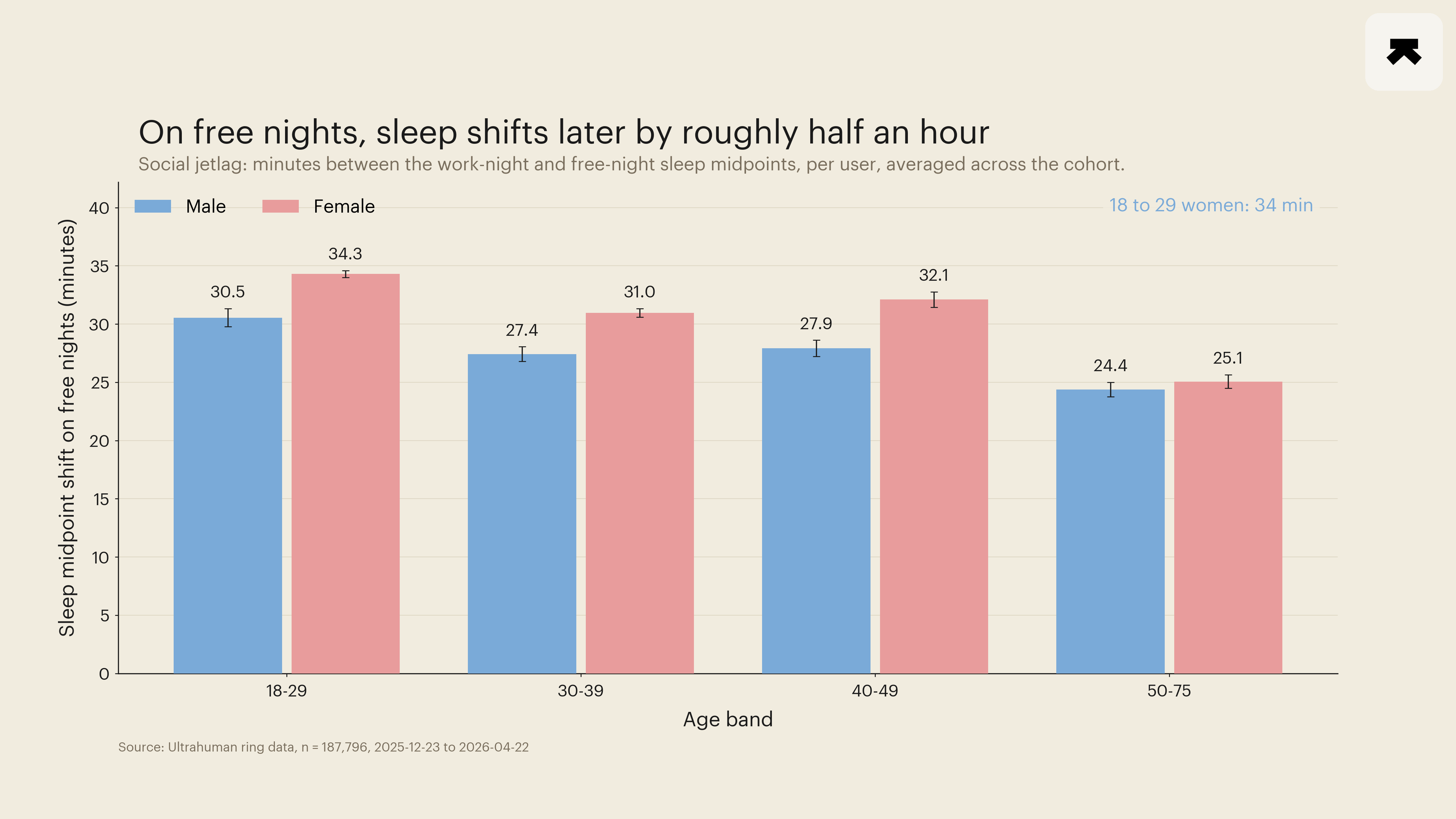
Sleep midpoints land 24 to 34 minutes later on free nights, and overnight resting heart rate rises in every one of eight age-by-sex cells. The cost is largest in women aged 18 to 29 and roughly halves by 50.
Social jetlag, the offset between sleep timing on free days and on work days, was named twenty years ago for the circadian misalignment that arises when social schedules disagree with the body clock (Wittmann et al., 2006). A 65,000-respondent survey showed the exposure is sharply age-graded, peaking in the early twenties and declining through adulthood (Roenneberg et al., 2012). The overnight autonomic cost has not been measured at population scale on consumer wearables.
Eligible members were Ultrahuman ring wearers aged 18 to 75 in Western timezones with at least 20 valid work-night and 8 valid free-night records over the 120 days ending 22 April 2026. For each, we computed median sleep midpoint (the clock-time halfway between falling asleep and waking) on work and free nights, and the within-person free-minus-work delta in overnight resting heart rate and HRV. The cohort split into eight cells across four age bands (18-29, 30-39, 40-49, 50-75) and two sexes; smallest cell n = 10,695.
The exposure itself reproduces the Roenneberg gradient. Mean per-user social jetlag ran 34.3 minutes in women aged 18 to 29, fell to 25.1 minutes in women aged 50 to 75, and tracked a flatter version of the same arc in men (30.5 minutes at 18-29; 24.4 at 50-75). Within every band, women carried 3 to 5 minutes more social jetlag than men.
The autonomic cost mirrors the exposure. Free-night minus work-night overnight resting heart rate was positive in every cell, with every 95 percent confidence interval clearing zero:
- 18 to 29, women: +0.66 bpm, 95% CI +0.64 to +0.67
- 18 to 29, men: +0.61 bpm, CI +0.58 to +0.64
- 30 to 49, women: +0.36 to +0.46 bpm
- 30 to 49, men: +0.48 to +0.55 bpm
- 50 to 75, women: +0.28 bpm, CI +0.26 to +0.31
- 50 to 75, men: +0.33 bpm, CI +0.30 to +0.35
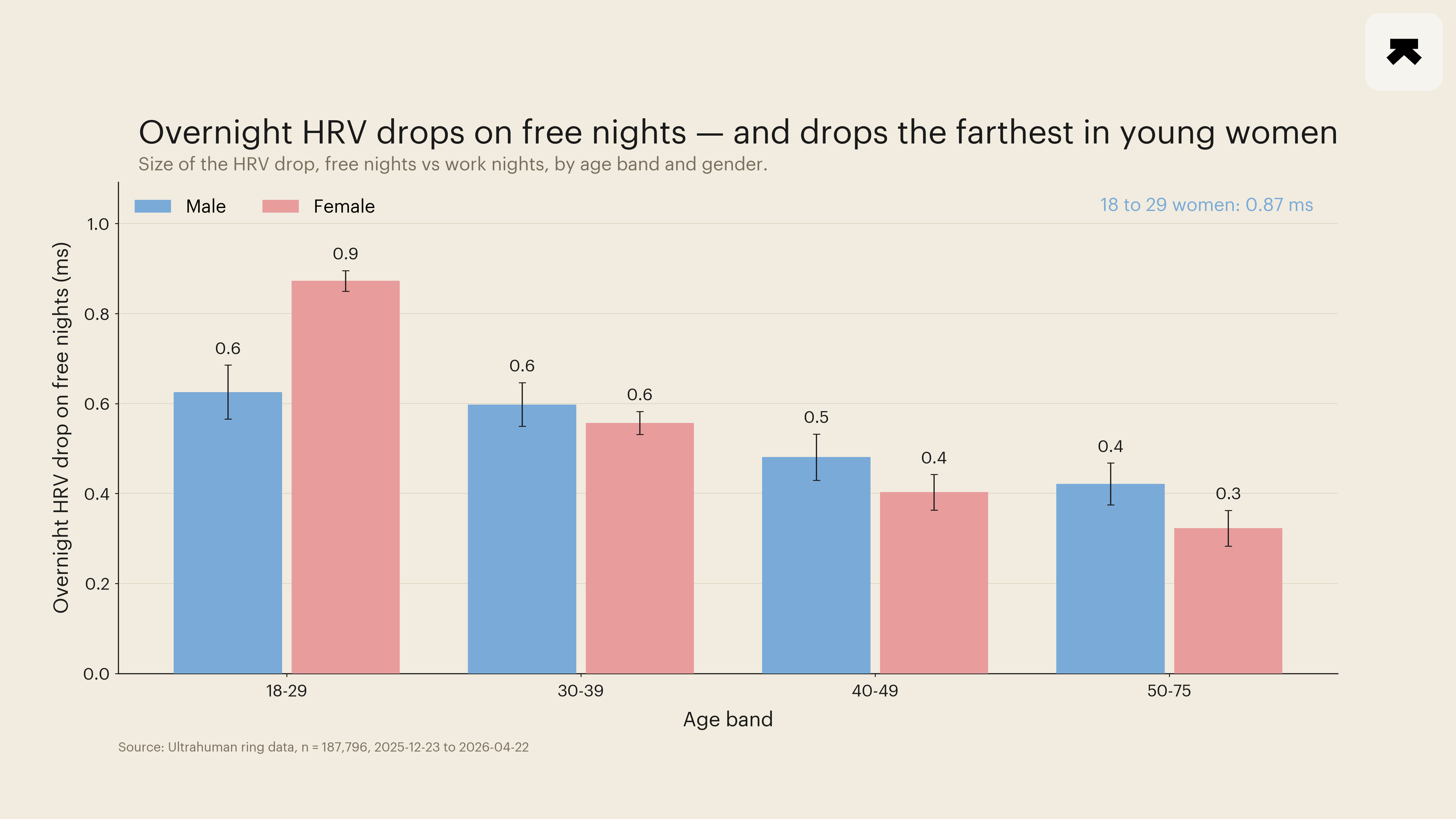
Overnight HRV moved in the opposite direction on the same gradient, falling 0.87 ms in women aged 18 to 29 and 0.32 ms in women aged 50 to 75. Two autonomic markers rising and falling together at this cohort size is the pattern circadian misalignment predicts.
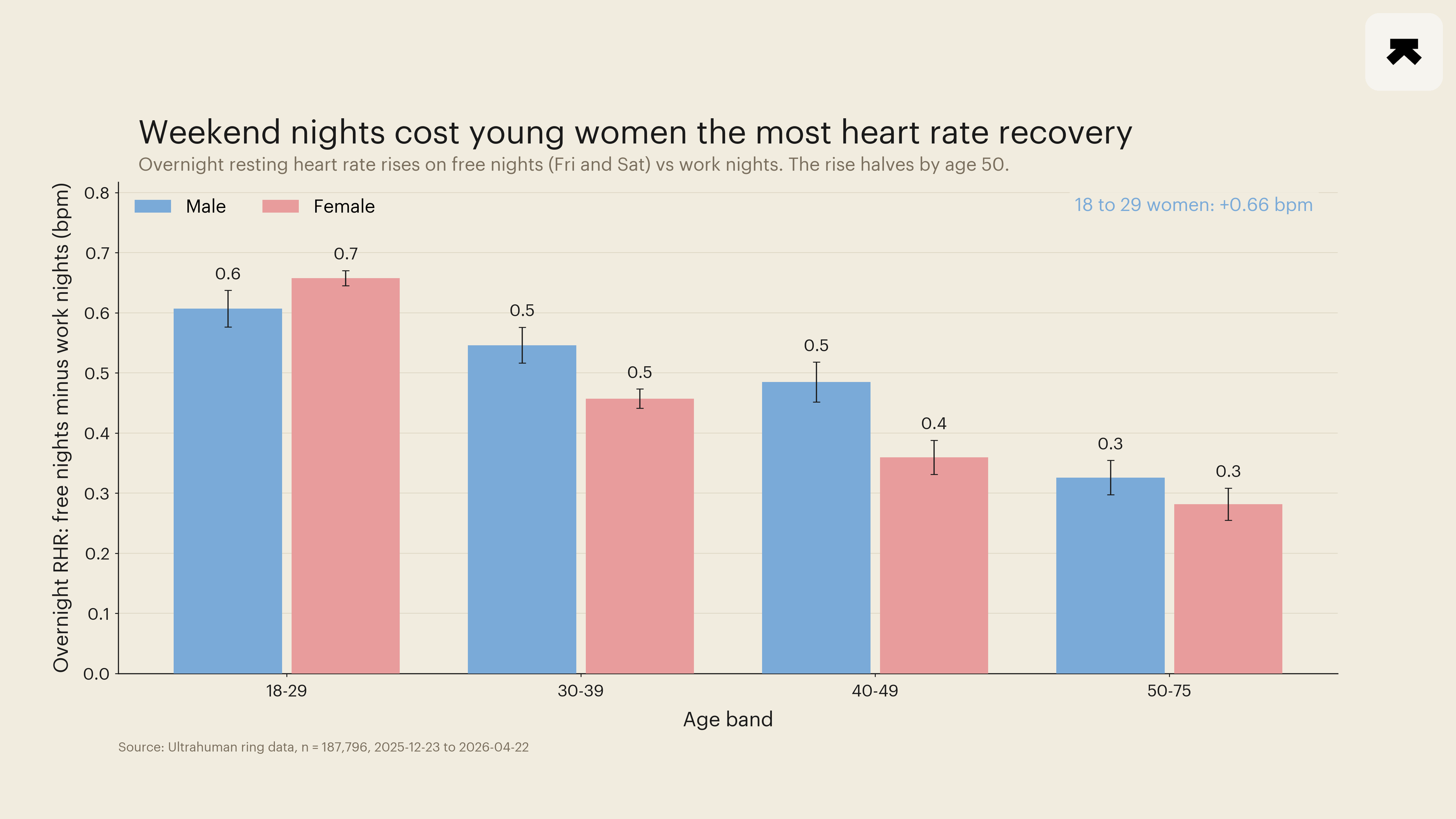
The heart-rate rise on free-night mornings was present in every cell, scaled with the size of the timing shift, and was mirrored by an HRV drop on the same gradient.
A 0.66 bpm overnight rise is small in isolation, but it sits on one of the most replicated cardiovascular risk markers and lands on the demographic carrying the largest exposure. The upstream physiology is circadian misalignment driving sympathetic activation during sleep (Shafer et al., 2023). Alcohol contributes too, especially in women under 35 (Grosicki et al., 2026), yet the weekend signal appears in every age band including the 50-plus group where drinking is typically lower. The eight-cell pattern reproduced on two non-overlapping 60-day sub-windows. The design is observational; the ring sees the aggregate weekend autonomic footprint, not the contribution of any single behaviour.
Both overnight resting heart rate and HRV register the weekend clock shift in a single night of ring data, in every age band and in both sexes.
A construct that took the Munich Chronotype Questionnaire and decades of survey work to establish is visible on ring telemetry inside the autonomic signal of one overnight window.
- Wittmann M, Dinich J, Merrow M, Roenneberg T. Social jetlag: misalignment of biological and social time. Chronobiology International, 2006. PMID: 16687322.
- Roenneberg T, Allebrandt KV, Merrow M, Vetter C. Social jetlag and obesity. Current Biology, 2012. PMID: 22578422.
- Shafer BM, Kogan SA, McHill AW. Pressure building against the clock: recent advances in understanding the consequences of circadian misalignment on cardiovascular physiology. Current Hypertension Reports, 2023. PMID: 37837518.
- Grosicki GJ, et al. Within-person changes in alcohol consumption are associated with diminished objective sleep quality, autonomic nervous function, and physical activity in 20,968 wearable device users. PLOS Digital Health, 2026. PMID: 41801993.