
Across 89 days around a HYROX race, one athlete's recovery overshot baseline by 19% and sleep HRV by 44%
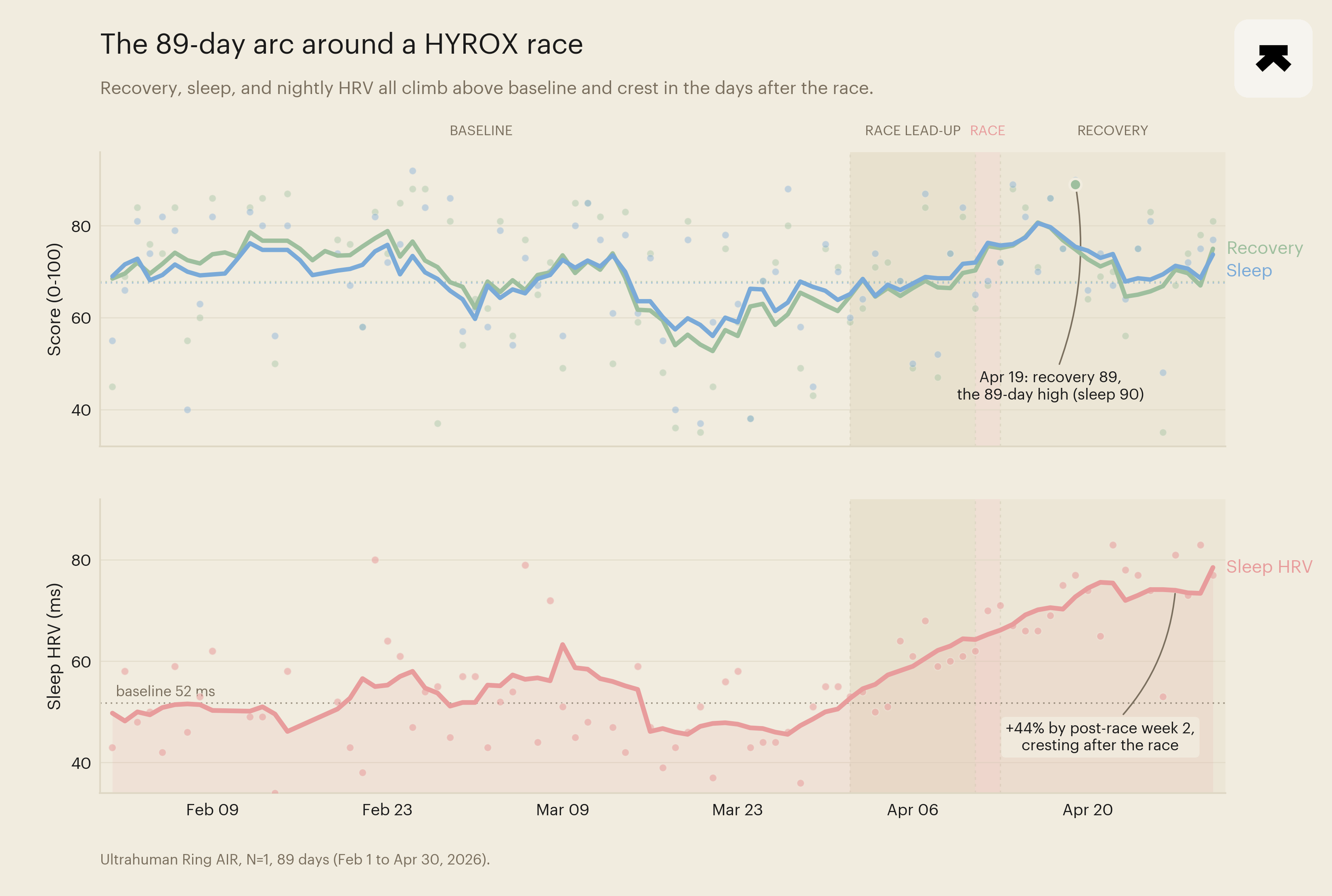
The race's biggest signals came after the finish line, not during it. Sleep held 97% efficient on both race nights, and recovery peaked at its 89-day high a full week later, with no recovery plan at all.
HYROX is a hybrid endurance race: eight 1-kilometre runs alternating with eight functional stations. A one-shot lab test (VO₂max, lactate threshold, maximum heart rate) sizes up an athlete for it but captures a single controlled hour [1, 2]. It cannot show how the body primes before a race, what completing it costs, or how long recovery takes; that trajectory has historically required a sleep lab to measure.
One athlete, a 32-year-old recreational competitor, wore an Ultrahuman Ring AIR for 89 consecutive days bracketing his HYROX Doubles race, which he finished in 1 hour 40 minutes. A pre-race lab test placed his peak VO₂ at 45.3 mL/min/kg (107% of age-predicted, classed "Good"). Every number below is read from the ring's daily recovery, sleep, and HRV metrics, against a 59-day baseline.
- Before the race, an autonomic taper. Daytime resting heart rate fell from 69 to 64 bpm and nightly sleep HRV rose from a 52 ms baseline to 58 ms as structured training came off, the early signature of a taper [3].
- On race nights, efficient sleep despite peak exertion. Both nights held 97% sleep efficiency, above the 93.6% baseline. Race eve carried 85 minutes of deep sleep and only six toss-and-turn events, with night resting heart rate dropping to 50 bpm despite race-day exertion of 11,847 steps, more than double baseline.
- After the race, an overshoot. Recovery averaged 80.7 in the week after, 19% above baseline, peaking at 89 on Day +7 (the single highest reading of the 89 days); nightly sleep HRV kept climbing to a 74 ms mean, 44% above baseline.
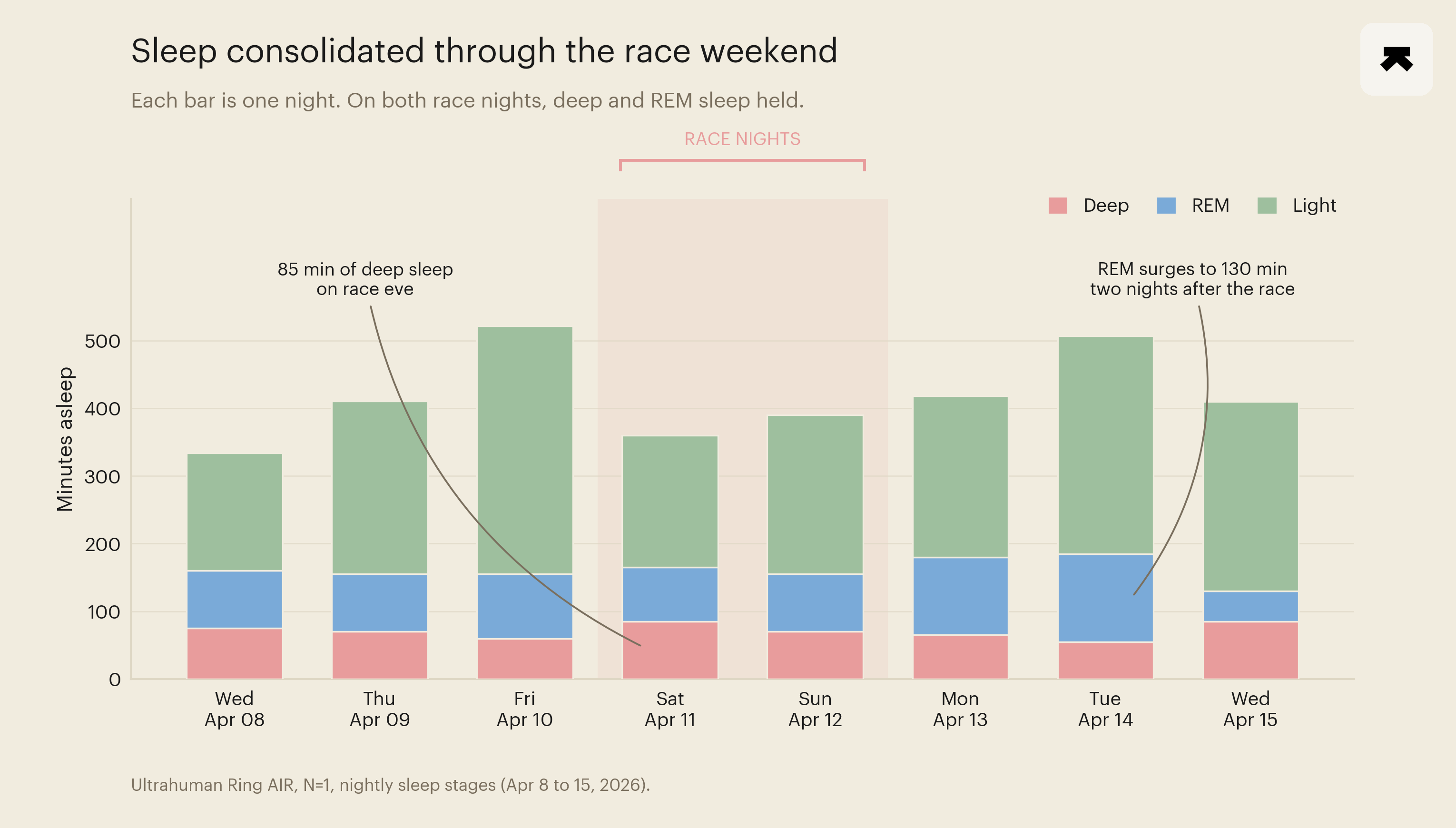
When the body is sufficiently taxed, sleep consolidates rather than fragments: the parasympathetic rebound during sleep prioritises repair over the day's sympathetic load [4].
Two weeks after the race, the readings split. Recovery score had returned to baseline (68, indistinguishable from before), but sleep HRV stayed at 74 ms. The autonomic adaptation outlasted the score peak. The overshoot is the striking part, because it came with no protocol: no programmed rest, no sauna or cold work. The athlete returned to regular training, and the body rebuilt past baseline on its own. This is super-compensation, and only a monitor running through every night could capture it [5].
A lab test describes one controlled hour. The ring captured the arc around it: how the body primes, what it costs, how it rebuilds, none of it prompted. This is one athlete; whether the arc generalises is a question for a cohort.
- HYROX. "HYROX World Series of Fitness Racing." hyrox.com, accessed 2026.
- Bassett DR, Howley ET. "Limiting factors for maximum oxygen uptake and determinants of endurance performance." Med Sci Sports Exerc 2000;32(1):70–84.
- Mujika I, Padilla S. "Scientific bases for precompetition tapering strategies." Med Sci Sports Exerc 2003;35(7):1182–1187.
- Halson SL. "Sleep in elite athletes and nutritional interventions to enhance sleep." Sports Med 2014;44(Suppl 1):13–23.
- Issurin VB. "New horizons for the methodology and physiology of training periodization." Sports Med 2010;40(3):189–206.