
Magnesium-tagged nights lift sleep score and lower overnight heart rate across 337,471 user-nights
On a user's magnesium nights versus their own other nights, sleep score sits 1.88 points higher and overnight heart rate 0.81 bpm lower.
Whether magnesium actually affects sleep has not been settled by the clinical literature. The most rigorous recent trial of magnesium bisglycinate cut insomnia severity at Cohen’s d 0.2 in 155 adults (Schuster et al., 2025); a ring-instrumented trial of magnesium L-threonate showed gains in deep and REM scores (Hausenblas et al., 2024); a 2021 meta-analysis pooled too little data for a quantitative summary (Chan and Lo, 2021). The mechanism runs through GABA-A modulation and a co-factor step in melatonin synthesis (Yeom and Cho, 2024).
Eligible users logged at least three magnesium nights via in-app smart tags between 2025-06-04 and 2026-05-05, plus at least three untagged nights with a valid ring sleep score. 1,692 users contributed 14,916 magnesium nights and 322,555 untagged ones. Each served as their own control, with Holm-Bonferroni-corrected one-sample t-tests on per-user differences across eight primary outcomes. The within-person design sidesteps the confound of comparing loggers to non-loggers.
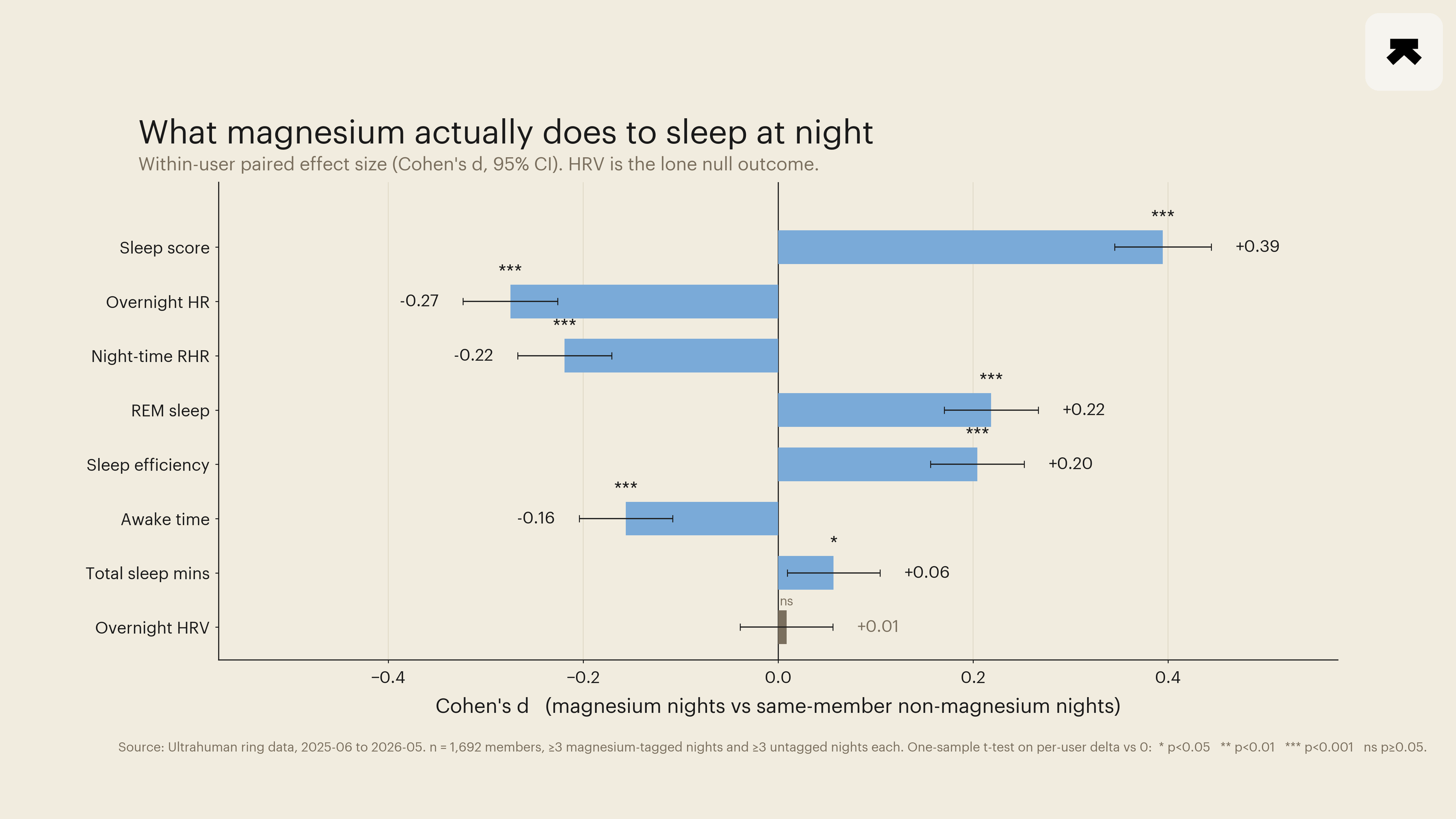
Six outcomes shifted with effect sizes worth interpreting:
- Sleep score: +1.88 points (d 0.39)
- Overnight heart rate (average across the night): −0.81 bpm (d 0.27)
- Night-time resting heart rate (sleep window only): −0.60 bpm (d 0.22)
- REM sleep: +4.06 min (d 0.22)
- Sleep efficiency: +0.62 pp (d 0.20)
- Awake time: −2.66 min (d 0.16)
Total sleep duration moved by about two and a half minutes (p 0.02 unadjusted, p 0.04 Holm), too small to call a real shift in time asleep. Overnight HRV did not move (mean within-person difference 0.05 ring units, CI crossing zero, p 0.72). The cardiac quieting therefore lives in heart rate alone, a separation small trials are usually underpowered to characterise.
Members who logged ten or more magnesium nights showed the largest sleep-score effect (d +0.52), consistent with either dose-response or a more habits-tracking subset. Men showed about 60 percent larger sleep-score effects than women (d +0.53 vs +0.35).
Generic magnesium and magnesium bisglycinate moved sleep score identically (d +0.38). A permutation test that randomised which nights were labelled magnesium collapsed the cohort effect from 1.88 to roughly 0.04, confirming the signal does not come from chance assignment.
Across 1,692 members and 337,000 paired nights, two orders of magnitude more than the largest placebo-controlled magnesium-and-sleep trial published, the clinical-trial signal carries to the field. Sleep score lifts. Overnight heart rate drops. HRV does not move. At population scale, the lab effect translates only to heart rate.
- Chan V, Lo K. Efficacy of dietary supplements on improving sleep quality: a systematic review and meta-analysis. Postgraduate Medical Journal, 2021. PMID: 33441476.
- Hausenblas HA, Lynch T, Hooper S, et al. Magnesium-L-threonate improves sleep quality and daytime functioning in adults with self-reported sleep problems: a randomized controlled trial. Sleep Medicine: X, 2024. PMID: 39252819.
- Schuster J, Cycelskij I, Lopresti A, Hahn A. Magnesium bisglycinate supplementation in healthy adults reporting poor sleep: a randomized, placebo-controlled trial. Nature and Science of Sleep, 2025. PMID: 40918053.
- Yeom JW, Cho CH. Herbal and natural supplements for improving sleep: a literature review. Psychiatry Investigation, 2024. PMID: 39086164.