
Bedtime regularity tracks overnight resting heart rate in 103,490 ring wearers, independent of total sleep time
The most irregular sleepers carry 1.9 to 3.6 bpm more overnight resting heart rate than the most regular in their age group, with HRV falling in step.
Sleep-timing regularity has overtaken total sleep duration as the cardiovascular sleep variable of interest. The Sleep Regularity Index (SRI; Phillips et al., 2017) outperforms sleep duration for mortality (Windred et al., 2024) and predicts incident dementia (Bian et al., 2025). On 103,490 long-term Ultrahuman ring wearers, the same gradient appears at the level of a single overnight readout.
SRI is defined on a minute-by-minute sleep/wake grid, which a ring's nightly timestamps cannot directly produce. We used the standard alternative: per-user standard deviation of midsleep time (the clock-time halfway between falling asleep and waking), which captures night-to-night timing jitter and tracks SRI closely.
Eligible members were long-term Ultrahuman ring wearers with ≥180 valid sleep nights (each ≥180 minutes) in the year ending 20 April 2026. The 103,490 members were split into ten regularity deciles (most-regular to least-regular) within each of three age groups (under 30, 30 to 44, 45 and over); smallest cell n = 938.
Primary readout: mean overnight resting heart rate per cell. The gap between most-regular and least-regular sleep-timing deciles, by age group:
- Under 30: 65.9 versus 67.7 bpm; gap 1.9 (95% CI 1.5 to 2.3)
- 30 to 44: 65.1 versus 68.7; gap 3.6 (CI 3.3 to 4.0)
- 45 and over: 64.4 versus 68.0; gap 3.6 (CI 3.0 to 4.2)
The heart-rate gap grew steadily from the most-regular to the least-regular sleepers, persisted regardless of how long they slept, and was matched by HRV falling in the opposite direction by 1.4 to 1.8 ms (Figure 1).
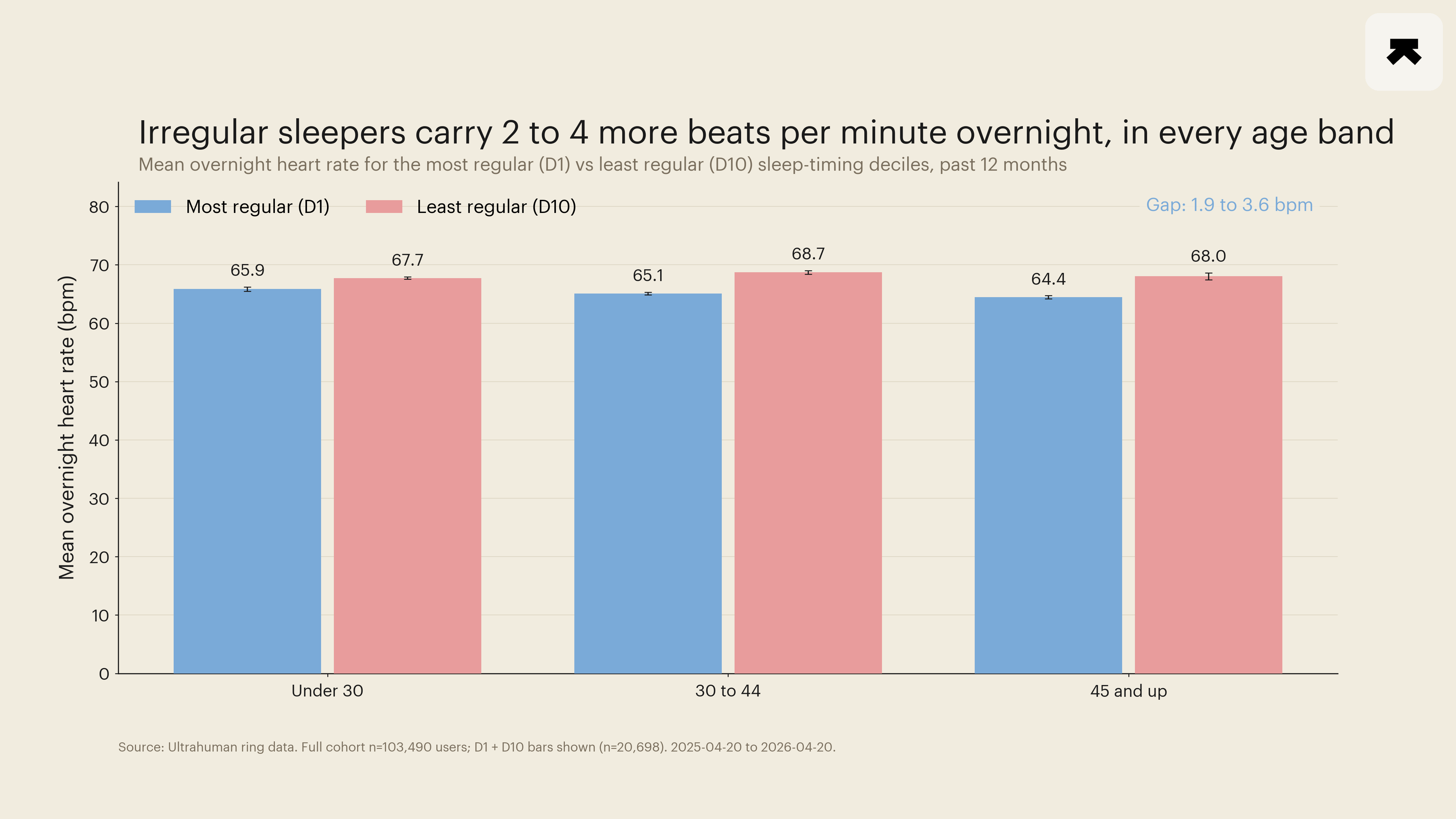
Pooled across age groups, the cohort shows no gap. Less-regular sleepers skew younger and start from a lower baseline heart rate, so a 25-year-old irregular sleeper at 66 bpm cancels a 50-year-old regular sleeper at 67 bpm in the pooled average: the within-age effect buried by the between-age effect, a Simpson's paradox.
A 3-bpm overnight difference is modest in isolation, about the size separating sedentary from moderately active middle-aged adults. Overnight resting heart rate is among the most replicated cardiovascular risk markers, so this magnitude is small but biologically pointed. The finding concords with Windred and Bian in direction and magnitude on different designs and regularity measures: three independent observational lines pointing the same way.
In a single night of ring data, both resting heart rate and HRV pick up sleep-timing irregularity, in every age group examined.
That a population-scale signal which took the UK Biobank years of follow-up to surface is visible inside one overnight window is the point.
- Phillips AJK, Klerman EB, Czeisler CA, et al. Irregular sleep/wake patterns are associated with poorer academic performance and delayed circadian and sleep/wake timing. Scientific Reports, 2017. PMID: 28607474.
- Windred DP, Burns AC, Lane JM, et al. Sleep regularity is a stronger predictor of mortality risk than sleep duration: a prospective cohort study. Sleep, 2024. PMID: 37738616.
- Bian Z, et al. Association of sleep regularity index with incident dementia and brain structural changes: a prospective cohort study. BMC Public Health, 2025. PMID: 39920677.