
Hot flashes shift sleep toward lighter stages and raise overnight heart rate, across 2,789 Ring members
Across 145,734 paired nights between June 2025 and May 2026, deep sleep falls 3 minutes, REM falls 6 minutes, overnight heart-rate variability drops 1.5 ms, and overnight heart rate runs 1.3 bpm higher. Each member's own non-tag nights within thirty days act as their baseline.
Nocturnal hot flashes are perimenopause's signature sleep disturbance. In a study of 29 healthy younger women given a gonadotropin-releasing hormone (GnRH) agonist (a drug class that briefly suppresses ovarian sex-hormone production to mimic the menopause hormonal state), each nighttime hot flash drove the time spent awake after falling asleep up by roughly 62 percent, measured via in-lab polysomnography (the clinical gold standard for overnight sleep monitoring).[1] A follow-up showed that around two-thirds of nocturnal hot flashes occur within five minutes of an awakening.[2] In a separate study of 11 perimenopausal women, each physiologically recorded flash drove heart rate up by roughly 4 beats per minute, with a sharp drop in vagal heart-rate variability (HRV), the parasympathetic-nervous-system component of HRV.[3] All three studies ran on under 30 women. None alone answers the question a wearable cohort can: does the same pattern hold across thousands of women sleeping in their own beds, over months?
Between June 2025 and May 2026, 2,789 members tagged at least one hot flash in the Ultrahuman app. We paired every tagged night against the same member's nights without a tag within thirty days, requiring a valid Ring sleep summary on both. The analysis: 4,226 hot-flash-tagged nights, 145,734 comparison nights, within-person design controlling for each member's age, baseline fitness, Ring fit, and seasonal context.
Every Ring readout that the menopause-sleep literature predicts a change in moves in the predicted direction. Overnight heart rate ran 1.29 bpm higher on tagged hot-flash nights (95 percent confidence interval, or CI, +1.06 to +1.51); HRV fell 1.53 ms; time awake rose 7.8 min; sleep efficiency fell 1.43 percentage points; deep sleep dropped 2.96 min; REM dropped 6.28 min; and the composite sleep score fell 2.25 points.
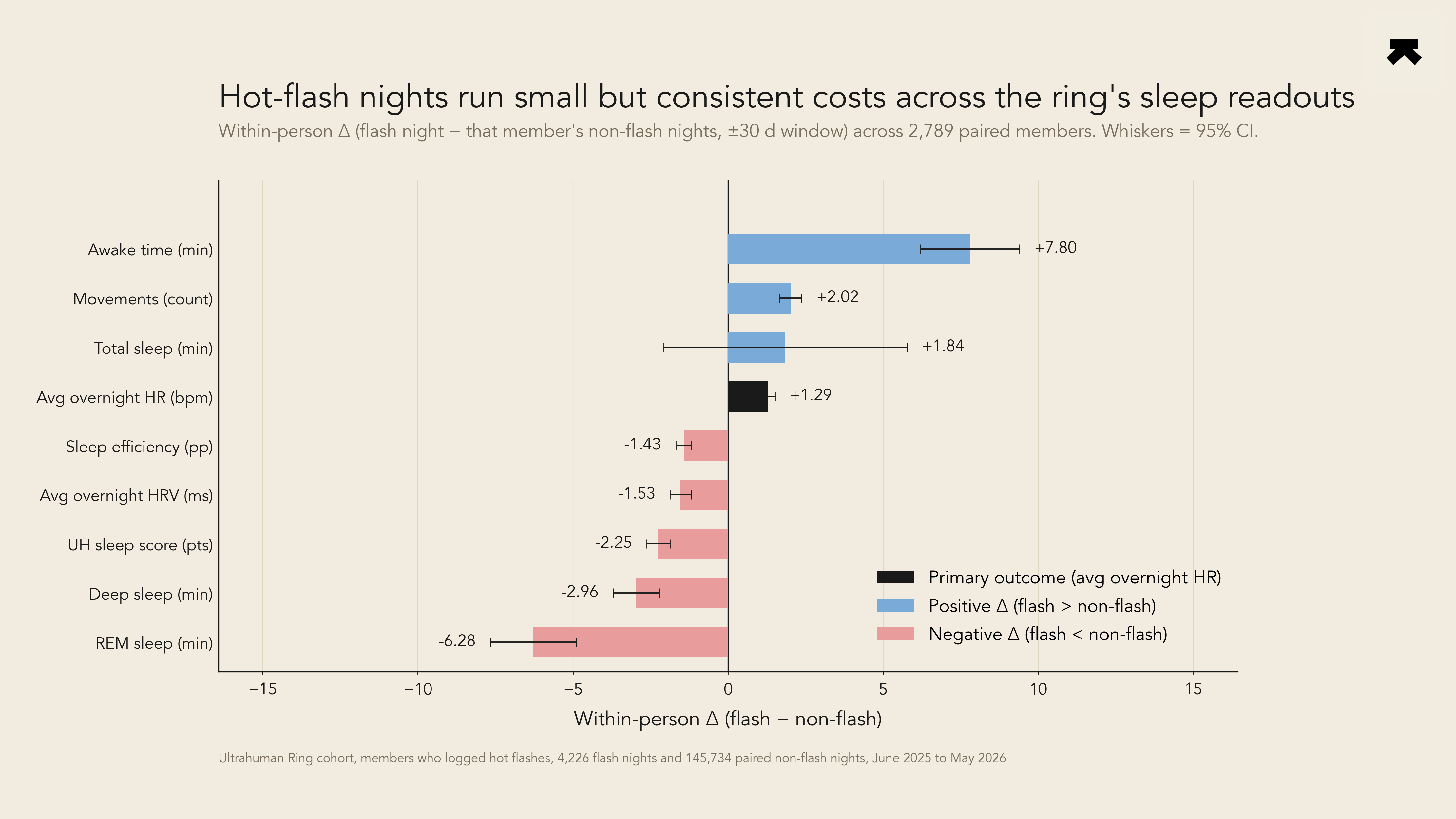
The direction matches the autonomic signature lab studies describe. That signature is the cluster of heart-rate rise, HRV drop, and brief movements that physiological recordings catch around each flash. The magnitude is smaller because the Ring records a whole-night average, not the brief event-window rise polysomnography isolates around each flash.[3] The 7.8-minute rise in time awake is the wearable-scale echo of Joffe's 62-percent finding,[1] and the rise in overnight movements echoes the awakening-cluster pattern Bianchi traced, in which flashes cluster within minutes of waking.[2] A night without a hot-flash tag in this cohort may still contain a sub-threshold flush a member did not tag, biasing the contrast toward the null and making the observed deltas conservative lower bounds. The cohort is defined by tagging behaviour, not clinical perimenopause status; age and sex are not stratified here, but explicit breakdowns become tractable as profile coverage thickens.
Members navigating perimenopause sleep complaints are losing the deeper, more restorative portion of sleep hours on the nights they report hot flashes. The Ring catches the same autonomic and fragmentation pattern in-lab studies described, at a scale large enough to see it as a population signal rather than a small-sample anomaly.
1. Joffe et al. Sleep 2013. PMID: [24293774] (https://pubmed.ncbi.nlm.nih.gov/24293774/).
2. Bianchi et al. Journal of Clinical Sleep Medicine 2016. PMID: [26951410] (https://pubmed.ncbi.nlm.nih.gov/26951410/).
3. de Zambotti et al. Menopause 2013. PMID: [23571526] (https://pubmed.ncbi.nlm.nih.gov/23571526/).